Of all the tissues in the body, nerves are the ones medicine has learned to fear. Bone knits. Skin closes. The liver regrows a lost lobe. But when a peripheral nerve is compressed too long, or an optic nerve is starved of its blood supply, the standard prognosis has a particular finality to it.
The word patients hear is permanent.
This article is about why that word may be less absolute than it sounds and why stem cells for nerve damage, and specifically pluripotent stem cells and the exosomes they release, appear to be especially suited to reaching nerve. We look at how nerve damage heals, what the published science on nerve regeneration actually shows, and what we can and cannot honestly claim from what we see in the clinic.
Many of the people who come to us arrive after being told their injury is permanent, and what we have watched happen, repeatedly and to our own initial surprise, is that nerve tissue is not always as fixed as that prognosis assumes.
How Does Nerve Damage Heal
To understand stem cells for nerve damage, it helps to start with how nerve damage heals at all, and why it so often does not.
Early in embryonic development, cells organize into three foundational layers, each giving rise to different tissues. Mesoderm becomes bone, cartilage, muscle, fat, and blood. Endoderm becomes the linings of the gut and lungs. Ectoderm, specifically its neuroectoderm and neural crest, becomes the nervous system: the brain, the spinal cord, the peripheral nerves, and crucially the Schwann cells that insulate and repair those nerves.
That last detail is the hinge of the whole argument. Schwann cells, the support cells that wrap peripheral axons in myelin, clear debris after injury, and orchestrate regeneration, are neural crest derivatives (3).
When a peripheral nerve is injured, these are the cells that must proliferate and guide repair. The reason nerve damage has so often been treated as permanent is not that nerves are forbidden from healing, but that the body’s own repair signals, in an injured adult, are frequently too weak and too late to finish the job.
Why Is Nerve Damage Often Called Permanent
Because in an adult, the repair signal usually fades before the work is done. The cells that rebuild a nerve, especially the Schwann cells, need sustained instruction to proliferate, regrow axons, and remyelinate. When that signal is too weak or arrives too late, the nerve is left silenced rather than restored, which is what the label permanent really describes. Restoring that signal is the problem stem cells for nerve damage try to solve.
Stem Cells for Nerve Damage: How Regeneration Could Work
This is the gap that stem cells for nerve damage are meant to fill. The idea behind stem cells for nerve damage is simple: supply the repair signal an injured nerve is missing. In practice, what acts on the nerve depends on where the cells come from.
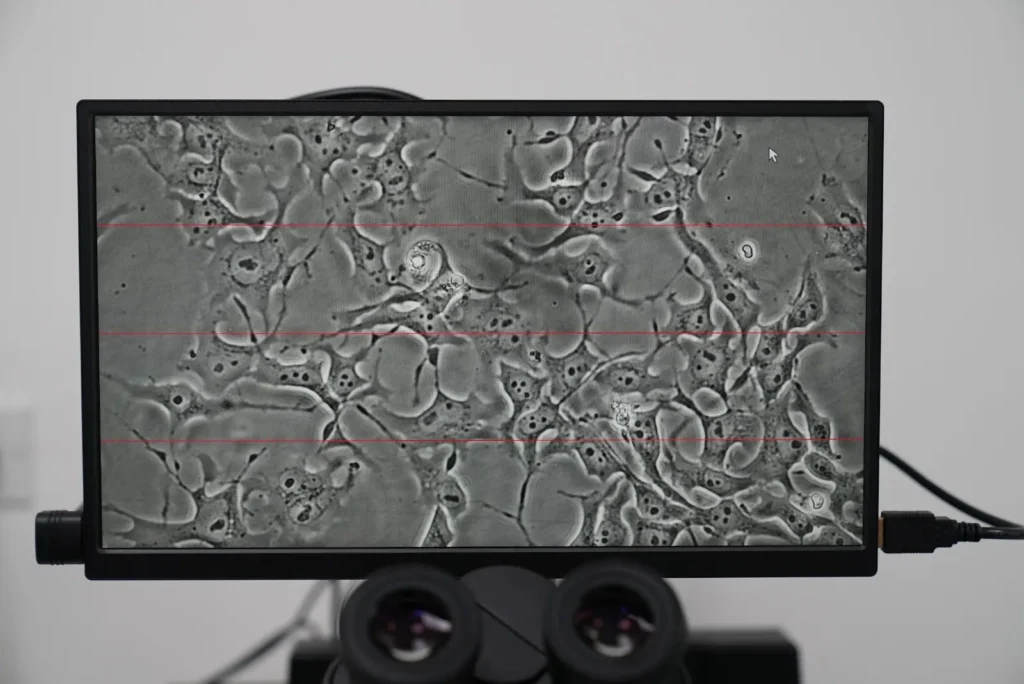
When they are donor cells, with DNA different from yours, the body does not keep them, so the active ingredient is always the exosomes they release: tiny signaling packages that carry the instructions for regeneration to the cells that need them.
When the cells are autologous, grown from your own cells and carrying your own DNA, they can remain in the body, and then both the cells and the exosomes they release do the work.
When those signals reach the injured nerve, they act on the Schwann cell and mobilize the coordinated program a nerve needs to come back: Schwann-cell proliferation, axonal regrowth, remyelination, and the new blood supply that supports them.
That is the logic behind stem cell therapy for nerve damage, and it is what the patient accounts and the laboratory studies, in their different ways, both point toward.
Put simply, stem cells for nerve damage aim to restore a signal, not to replace the nerve.
A Recovery We Did Not Expect
One patient, a writer in her sixties, shared her account with us with her consent. She had spent roughly twelve years largely housebound after a femoral nerve compression at the L2-L3 level went undiagnosed through its critical first year and became, in her American doctors’ language, a permanent motor-nerve injury. She lived in six-hour cycles between doses of pain and anti-spasticity medication.
After beginning pluripotent stem cell treatment, the changes she reported were concrete rather than abstract. She woke in the night after the third day sensing something had shifted. By the fourth day she found herself standing at the bathroom door, having walked there, with her wheelchair still back in the bedroom. Within about six months, she went from primarily housebound to living, in her words, an almost fully independent life.
We share this as a story, not a study. One person’s recovery does not prove a treatment. But it frames the scientific question precisely: what could allow tissue written off as permanent to rebuild its function, and why nerve, of all things?
Curious Whether Stem Cells Could Help Your Nerve Damage
Speak with our patient care team about your injury and whether pluripotent stem cell treatment might apply to you.
Pluripotent Stem Cells and Nerve Regeneration
The case for using stem cells for nerve damage, and pluripotent stem cells in particular, starts with where nerves come from. A pluripotent stem cell is defined by being able to give rise to all three germ layers, and its signaling, the factors carried in its secretome, reflects that full competence natively, including the neuroectodermal programs that nerve tissue is built from.
When such a cell, or its exosomes, arrives at an injured nerve, it is not being asked to do anything foreign to its nature. Neural lineage is part of its default vocabulary, which is why pluripotent stem cells and nerve regeneration are so closely linked.
Why Not Mesenchymal Stem Cells
Mesenchymal stem cells (MSCs), the workhorses of most stem cell clinics and typically drawn from fat, bone marrow, or perinatal tissue, are principally mesodermal in character. Their reliable, native outputs are the mesodermal tissues: bone, cartilage, and fat. MSCs can be coaxed toward neural-like cells under laboratory induction, and MSC exosomes have shown real benefit in nerve-injury research (4). The neural door is not closed to them.
But there is a difference between what a cell can be pushed to do and what it does by default. For MSCs, neural signaling is a coaxed, variable capacity; for pluripotent cells, neuroectodermal competence is intrinsic. That is a plausible reason the nerve-repair signal carried by pluripotent-derived cargo tends to be richer and more consistent, speaking the language natively rather than in translation.
What Does the Preclinical Science Show
The evidence base for stem cells for nerve damage is still mostly preclinical, meaning laboratory and animal studies rather than large human trials. In controlled rat models of sciatic nerve crush injury, exosomes derived from induced pluripotent stem cells were taken up by Schwann cells and drove their proliferation, the essential first step of peripheral nerve regeneration.
A 2025 safety-and-efficacy study found that iPSC-derived exosomes injected at the injury site improved axonal regeneration, myelination, Schwann-cell activation, and angiogenesis, with measurable functional recovery assessed by gait, grip strength, and pain response (1). A separate line of work used acellular nerve grafts supplemented with iPSC-derived exosomes to bridge a 15 mm gap in rat sciatic nerves, achieving motor recovery comparable to a nerve autograft, the surgical gold standard, with no significant difference in reinnervated muscle fibers (2).
Across these studies the exosomes did not simply supply one growth factor; they acted on the Schwann cell and mobilized the whole coordinated program of regeneration, remyelination, and revascularization that a nerve needs.
Peripheral Nerve Regeneration: Why the PNS Can Repair Itself
The peripheral nervous system (PNS) is the part of the body where nerve repair has been studied most, and it is where the mechanism behind stem cells for nerve damage is easiest to see, because peripheral nerve regeneration has been mapped in detail. The reason, again, is the Schwann cell.
After a peripheral nerve is injured, Schwann cells can shift into a repair state, clear debris, and form the guiding pathways that lead a regrowing axon back to its target. The PNS, in other words, retains an intrinsic repair program that the right signal can amplify.
This is why the pluripotent-derived signal fits peripheral nerve regeneration so well. It speaks directly to the Schwann cell, the neuroectodermal repair cell, in its native language, which is exactly the behavior the developmental argument predicts and the animal studies show.
Is Stem Cell Therapy for Peripheral Nerve Damage Proven in Humans
Not yet, and this is worth stating plainly. The mechanistic case and the animal data for stem-cell-based peripheral nerve repair are strong, but robust human clinical evidence remains limited.
Recent reviews make the same point: the laboratory results are encouraging, yet large, controlled human trials have not caught up. What we report from our own practice is observational, gathered case by case, so stem cells for nerve damage remain, in humans, an area of active study rather than settled treatment, and it should be read as clinical experience rather than proof.
Been Told Your Nerve Injury Is Permanent
Our patient care team can walk you through what the science shows and what a personalized plan could look like.
Central Nervous System Repair: Why the Brain and Spinal Cord Are Different
The central nervous system (CNS), meaning the brain, the spinal cord, and the optic nerve, works differently from the peripheral system, and that difference is where our clinical experience has been most encouraging. Textbooks have long treated the CNS as fixed, because it lacks the Schwann-cell repair program of the peripheral nerves and does not, on its own, invite axons to regrow.
What we have seen, early and consistently, is different: how quickly the central nervous system responds to pluripotent stem cells. Brain improvement in particular is one of the areas we focus on most, and the response is often faster than the peripheral picture would lead you to expect.
The mechanism is almost certainly different from the Schwann-cell route that drives peripheral nerve regeneration, but in practice it works, and it works well. It is one of the clearest signs that stem cells for nerve damage are not limited to the peripheral nerves.
The optic nerve is the one place we stay more measured, simply because fewer of the people who come to us arrive with optic-nerve damage; there we can point only to encouraging anecdotal improvement rather than a consistent pattern. What is clear across the central nervous system is that a signal able to engage neuroectodermal repair is not restricted to the peripheral nerves.
The reach of stem cells for nerve damage extends here because a pluripotent-derived exosome can cross the blood-brain barrier, as we discuss in our companion work on exosome cargo, which is the practical prerequisite for reaching central tissue at all. Notably, the wider field’s first human reprogramming trials have chosen to begin with the eye, an independent signal that this is serious ground (5).
Can Stem Cells Repair the Brain or Spinal Cord
The brain is where we have seen some of our most encouraging responses. In our clinical experience it often responds quickly to pluripotent stem cells through a mechanism that likely differs from peripheral repair, and we report that as a clinical observation rather than a trial-proven outcome.
We stay more cautious about the optic nerve, where our experience is still limited to anecdotal improvement. For the brain, though, stem cells for nerve damage are one of the areas we are most optimistic about, and the overall direction is genuinely promising.
The Future of Stem Cell Therapy for Nerve Damage
Nerve repair is exactly the kind of subject where hope outruns evidence, and the future of stem cell therapy for nerve damage depends on keeping the two apart.
What is well supported about stem cells for nerve damage is specific: pluripotent cells are developmentally competent for the neuroectodermal lineage nerve comes from, and their exosomes drive Schwann-cell proliferation, axonal regeneration, remyelination, and functional recovery in controlled preclinical models. What is not yet settled is whether those results translate into large, controlled human outcomes.
Nerve regeneration is also gradual and variable; the patient whose account opened this article described episodes that felt like going backwards before recovery continued.
The Hidden Nerve Component of Joint Pain
A degenerative joint is not only cartilage and bone. Its capsule, ligaments, and surrounding tissue are densely innervated, and much of the chronic pain of a worn joint is a nerve phenomenon as much as a structural one. Because pluripotent-derived signals engage both the mesodermal tissues (cartilage and bone) and the neuroectodermal ones (the nerve fibers), they can address a joint from both sides at once, supporting the structure and the nerves that report its pain.
It is the same reasoning that makes stem cells for nerve damage worth studying elsewhere in the body. We think this dual action is part of why the joint-pain relief we observe is often more complete than structural repair alone would predict.
What Can and Cannot Be Claimed Today
The mechanistic case is strong, and the clinical pattern we see is consistent, but neither is a promise of outcome for any individual, and preclinical evidence is not the same as proven human treatment. What we can say is that the developmental logic, the published mechanism, and the clinical pattern for stem cells for nerve damage all point in the same direction, and that convergence is worth taking seriously.
Nerve damage has been treated as permanent not because nerves are forbidden from healing, but because the body’s own repair signals, in an injured adult, are too weak and too late. What a pluripotent secretome offers is that missing signal: the same developmental language nerve tissue was built with, delivered again to cells that had given up. Schwann cells begin to proliferate. Axons find their way. The wiring, often, heals.
For anyone weighing stem cells for nerve damage, that is the point that matters most. Permanent is a prognosis, not always a fact. If you or someone you care for has been told a nerve injury is permanent, we would be glad to talk with you about whether this approach might apply.